

From Line to patient: what does that do to who I am?
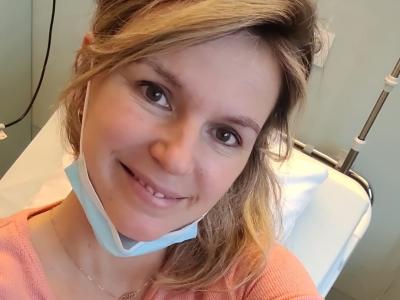
Putting on the hospital wristband. From that moment on, I’m no longer just Line, but also a patient. There’s simply no time to let it sink in calmly. I don’t slide gradually from Line to patient. The shift is abrupt. From one moment to the next, my life takes a completely different turn.
To get through a journey like this mentally, I distance myself from who I am. Sometimes on purpose, as a way of protecting myself. But sometimes without realising it, and along the way I lose little pieces of myself.
Learning to ask for help
I grew up learning that I should be strong and brave when things go wrong. And that it’s better to say “here you go” than “thank you.” I learned to take care of others. It felt familiar, almost natural. It even became my job. So, it felt deeply unnatural to suddenly be the one who needed care. To have to say thank you more often. To have to ask for help, when I was so used to offering it. It made me vulnerable, and sometimes a bit helpless too.
My treatment didn’t just change how I felt inside, but also how I looked on the outside. The exhaustion became visible. My skin changed, my hair got thinner, and the scale didn’t exactly bring me joy either. I used to feel at home in my own skin, but now I could be overwhelmed by deep sadness when I looked in the mirror. The face looking back at me felt less and less familiar. As if my body was telling a story in which I no longer fully recognized myself.
Searching myself in the mirror
And honestly? I’m still searching. I still don’t fully find myself in that reflection. Maybe one day I will, maybe I won’t. Maybe it’s not about everything going back to how it was, but about learning to look at who I am today. With everything that has changed, and everything that has stayed.
My tips for the mental challenges of this journey:
Write.
Writing helps me stay connected to myself. It gives words to feelings that would otherwise stay stuck somewhere inside. And later, I can read back over what I went through. Not just the hard moments, but also the happy memories, the small joys, and the moments when there was still room for lightness.
See an oncology psychologist.
Anneke is worth her weight in gold to me. With her, I can talk about the difficult things. Sometimes we understand them better together, sometimes we find an answer, and sometimes something simply becomes a little more bearable just by saying it out loud. An oncology psychologist isn’t only there for you as a patient, either. The people around you can benefit enormously from that support too.
Read other people’s stories.
And, reach out to others who are going through the same thing.
It can do you a world of good to read the stories of people who are going through something similar. To discover that feelings you struggle to explain are instantly recognizable to someone else. You feel less alone, and you don’t always have to explain everything.
That’s why I’m writing this blog. It means a lot to me that people recognize themselves in my words. If it helps them feel just a little less alone, that makes it truly worthwhile for me.
Dare to face yourself.
However hard it sometimes feels, try not to avoid yourself completely. Keep looking in that mirror, literally and figuratively. Give yourself room to be sad about what has changed, to miss what used to be, and to search for who you are today.
You don’t have to be strong every day.
You don’t have to make peace with everything that’s happened to you right away. But try not to lose yourself in the urge to just keep going.
Let gratitude bring gentleness, not guilt.
For me, gratitude increasingly lives in simple things. In small moments, in happy memories, in the people who are there for me, and in things that once seemed obvious but suddenly aren’t anymore. Sometimes that’s enough to make a day a little brighter.
About the author
Line Minne, breast cancer patient
Speech therapist, bitten by the language bug
From Line to patient: what does that do to who I am?
A cancer journey changes a lot: the people around you, your daily life, your body, the way you see the world. But also... your identity.
You end up in a role you never chose. You have to learn to live with change, with uncertainty, and with a body that no longer feels familiar. And all the while, you’re trying to keep your head above water mentally.
That’s where the real challenge begins for me: not trying to get everything back under control, but giving myself time to search, to feel and to grow. That’s why I’m writing this blog.
Why Anticancer Fund shares patient stories
At Anticancer Fund, we turn scientific evidence into care. For us, good care starts with scientific evidence, but it doesn’t stop there. That’s why we’re sharing Line’s story.
A diagnosis also affects how you feel, how you look and who you are. You won’t read that in study results, but it shapes how someone experiences their cancer journey. That’s why we listen to patients. Stories like Line’s remind us why we do what we do.
Thank you, Line, for sharing this so openly.